Ningbo
GDP: 1.87 trillion yuan (2025)
Permanent residents: 9.77 million (2024)
Location: Southeastern part of East China's Zhejiang province and southern wing of the developed Yangtze River Delta region.
Area: 9,816 square kilometers
Economy
Ningbo's economy remained generally stable in 2025. The city's gross domestic product (GDP) reached 1.87 trillion yuan ($268.94 billion), growing 4.9 percent year-on-year at constant prices.
The tertiary industry continued to account for a large show of growth, increasing 5.6 percent and accounting 61.9 percent of overall GDP growth, while the secondary industry expanded 4 percent and the primary industry rose 3.9 percent.
Industrial production, the backbone of Ningbo's economy, showed resilience. The added value of industrial enterprises above the designated size grew 5.3 percent year-on-year.
INingbo-Zhoushan Port continued to strengthen its role as a global shipping hub, with cargo throughput rising 4.9 percent and container throughput jumping 9.8 percent to 39.27 million twenty-foot equivalent units (TEUs).
The city's total foreign trade volume grew 2.6 percent to 1.46 trillion yuan, with private enterprises accounting for 77.9 percent of the total.
Urban residents reported per capita disposable income of 86,088 yuan, while that of rural residents reached 53,683 yuan. The urban-rural income ratio narrowed from the previous year to 1.60.
Administrative divisions
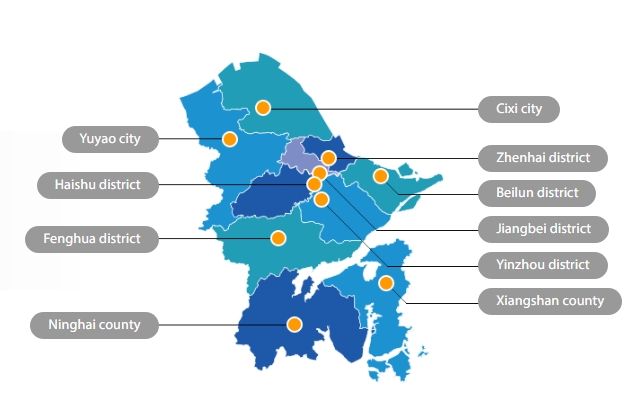
Ningbo governs six districts, two counties, and two county-level cities — Haishu district, Jiangbei district, Zhenhai district, Beilun district, Yinzhou district, Fenghua district, Ninghai county, Xiangshan county, Yuyao city, and Cixi city.
 Expats enjoy festive fun in Ningbo
  Horse motifs in China's intangible cultural heritage
  International friends join Chinese New Year festivities in Ningbo